Thursday, May 21, 2009

Wednesday, May 20, 2009
china source 4
http://www.travelchinaguide.com/intro/history/qing.htm
- The website of my source is http://www.travelchinaguide.com/
- My source is the Travel China Guide.
- The source doesn't have credentials.
- The source says
Tuesday, May 19, 2009
china source 3
http://www.mnsu.edu/emuseum/prehistory/china/later_imperial_china/qing.html
- http://www.mnsu.edu/
- Emuseum is the source.
- Credentials are none.
- The source says that the Qing Dynasty was the second time when all of China was ruled by foreigners, the Manchu. The first was during the Yuan Dynasty when China was completely controled by the Mongols. In terms of government, the Qing Dynasty adopted the form of government used by the Ming, with only minor adjustments. For example the positions were all dual positions, one Manchu and one Chinese were in the same position, with the Manchu having more power. The form of military organization that the Qing used was one of the best in the world. They organized their troops under banners, each of which was a separate unit. The number of banners grew from 8 in the beginning to 24. These fighting men were personally attached to the emperor, in fact he owned them. They were incredibly loyal to the emperor. The bannermen also functioned as a talent pool from which civil bureaucrats could be chosen.
- Yes I believe the source because it has artifacts from the Qing Dynasty in its museum so it shows that the facts that it talks about is true.
Wednesday, May 13, 2009
china source 2
http://en.wikipedia.org/wiki/Manchu
- The source is from the website Wikipedia.
- The source is Wikipedia.
- They don't have credentials.
- The source talks about and explains the history of the Manchu people and how they founded the Manchu Dynasty. During their rise in the seventeenth century with the help of Ming rebels, like Wu Sangui, the Manchu clan conquered the Ming Dynasty and founded the Qing Dynasty, which ruled China until the Xinhai Revolution of 1911, which established a republican government in its place. The Manchu ethnicity have largely been assimilated with the Han Chinese. The number of Chinese today with some Manchu ancestry is quite large, and the adoption of favorable policies towards ethnic minorities(such as preferential university admission and government employment opportunities) has encouraged some people with mixed-Han and Manchu ancestry to re-identify themselves as Manchu.
- Yes, I believe the source because it agrees with the other sources that I have looked up.
china source 1
http://en.wikipedia.org/wiki/Qing_Dynasty
- My source is from the website Wikipedia.
- My source is Wikipedia.
- They don't have credentials.
- The source says that the Qing Dynasty, also called the Manchu Dynasty, was the last ruling dynasty of China, ruling from 1644 to 1912. The dynasty was founded by the Manchu clan called Aisin Gioro in what is now northeast China (Manchuria). It was originally established as the Later Jin Dysnasty in 1616 but it later changed its name to "Qing" meaning "clear" or "pellucid" in 1636 and captured Beijing in 1644. During its reign, the Qing Dynasty became highly integrated with Chinese culture. However, its military power weakened during the 1800s, and faced with international pressure, massive rebellions and defeats in wars, the Qing Dynasty declined after the mid-19th century. The Qing Dynasty was overthrown following the Xinhai Revolution, when the Empress Dowager Longyu abdicated on behalf of the last emperor, Puyi, on February 12, 1912.
- Yes I believe my source because it gives supporting detail an backup to its information.
Tuesday, April 21, 2009
Rights Assignment
http://en.wikipedia.org/wiki/Freedom_of_assembly
http://members.mobar.org/civics/FreetoAssemble.htm
http://www.hrea.org/index.php?base_id=146
http://k12subjectguides.suite101.com/article.cfm/understanding_freedom_of_assembly
http://www.equalityhumanrights.com/en/yourrights/humanrights/pages/Righttopoliticalmeetings.aspx
http://www.firstamendmentcenter.org/assembly/index.aspx
http://www.usatoday.com/educate/college/casestudies/20061003-Assembly.pdf
http://martininthemargins.blogspot.com/2009/02/freedom-of-assembly.html
http://www.websters-online-dictionary.org/fr/freedom_of_assembly.html
http://www.commondreams.org/views05/1205-22.htm
- My right is Freedom of Assembly.
- To exercise this right is to have the individual right to come together with other individuals and express, promote, pursue, and defend common interests. A trade union is a way to exercise this right.
- The limitations on this right is that the people who want to organized a sit in, for example, can have meetings and they have the right to assembly as long as its nonviolent.
- These limitations exist because it would cause riots and a whole bunch of problems if they didn't exist.
- If I had to give up this right, in return I would want a compromise for what i was assembleling for, like social security or a fairer society.
Inconvenient Truth- fact 5
Fact: When the rays of the sun hit the Earth and it hits an ice cap, more than 90% of it was reflected but as the water is melting, more than 90% of the heat of the rays is absorbed by the water, making the planet warmer.
Inconvenient Truth- fact 4
Fact: Lake Chad, one of the largest lakes in the world, has now dried up to almost nothing due to global warming.
Inconvenient Truth- fact 3
Fact: When the southern hemisphere of the Earth is facing the sun during fall and winter, the CO2 level is higher than during the spring and summer when the northern hemisphere is facing the sun.
SOURCE 7: http://www.esrl.noaa.gov/gmd/ccgg/trends/
SOURCE 7: http://www.esrl.noaa.gov/gmd/ccgg/trends/
- The source is the Earth System Research Laboratory.
- The credentials of the source are the U.S. Department of Commerce and NOAA Research (National Oceanic and Atmospheric Association).
- The source is credible because it is checked by their department many times before it is published and its information is very accurate and tested by their researchers.
- The source says that on the graph, it shows that the level of carbon dioxide has increased by more than 2 million parts per year.
- I believe the source kind of because it does give proof about what it is talking about.
SOURCE 8: http://co2now.org/
- The source is "CO2 Now."
- The source's credentials are University of Victoria and International Polar Year (IPY) Joint Committee.
- The source is credible because it shows its credentials and who writes the articles and facts.
- The source says that global warming is mainly the result of CO2 levels rising in the Earth's atmosphere. Both atmospheric CO2 and climate change are accelerating.
- I don't know if I believe the source because it shows a graph as well from the Mauna Loa Observatory, Hawaii but it looks different than the one from the previous source.
SOURCE 9: http://www.nytimes.com/2008/04/24/science/earth/24brfs-GASESINATMOS_BRF.html
- The source is The New York Times.
- The source's credentials is NOAA.
- The source is credible because it gives credentials and the author's name who wrote the article.
- The source says that carbon dioxide is continuonly rising at an accelerating pace. After a decade of stability, even other heat-trapping gases, like methane, rose as well. NOAA says that the main reason why the carbon dioxide level reached up to 385 parts per million last year was because of the burning of fossil fuel.
- I believe the source because this is also what NOAA said in the first source that I looked up for this fact so it must be true.
Inconvenient Truth- fact 2
Fact: Greenhouse gases keep in the sun's radiation waves in the Earth, warming the planet.
SOURCE 4: http://www.eia.doe.gov/bookshelf/brochures/greenhouse/Chapter1.htm
SOURCE 4: http://www.eia.doe.gov/bookshelf/brochures/greenhouse/Chapter1.htm
- The source is EIA (Energy Information Administration).
- The source's credentials are the US Government.
- This is a credible source because it gives the original source where it go the main information from and it is updated every year.
- The source says that the greenhouse gases allow sunlight to enter the atmosphere freely. When the sunlight hit the Earth's surface, it is re-radiated back towards space as infrared radiation. Greenhouse gases absorb this infrared radiation and trap the heat in the atmosphere.
- Yes, I believe the source because it is a credible source and it supports its explanations of the greenhouse gases.
SOURCE 5: http://www.umich.edu/~gs265/society/greenhouse.htm
- The source is the Greenhouse Gases And Society by Nick Hopwood and Jordan Cohen.
- The credentials are the World Book Encyclopedia, US Government of State, and the Global Environment.
- The source is sort of credible because it gives primary sources where it got some information from but it doesn't give the profession or where the author went to university.
- The source says that the shorter wavelength radiations from the sun passes through Earth's atmosphere, then it is absorbed by the Earth's surface, causing it to warm. Part of the absorbed energy is re-radiated back to the atmosphere as long wave infrared radiation. The greenhouse gases selectively transmit the infrared waves, trapping some and allowing some to pass through into space. The greenhouse gases absorb these waves and reemits the waves downward, causing the lower atmosphere to warm.
- I believe the source because it explains the process well.
SOURCE 6: http://www.epa.gov/climatechange/emissions/index.html
- The source is the US EPA (U.S. Environmental Protection Agency).
- Its credentials is the U.S. government.
- This source is credible because it is updated frequently by the US EPA.
- The source says the gases that trap heat in the atmosphere are often called greenhouse gases. Some gases like carbon dioxide happen naturally and are emitted to the atmosphere through natural processes and human activity. Other greenhouse gases like fluorinated gases are created and emitted solely through human activity.
- I believe the source because it makes sense on what it is explaining.
Tuesday, April 14, 2009
Inconvenient Truth- fact 1
Fact: The radiation waves from the sun are absorbed by Earth and causes it to warm up. Then the radiation is re-radiated out of Earth as infrared waves.
SOURCE 1: http://science.hq.nasa.gov/kids/imagers/ems/infrared.html
SOURCE 1: http://science.hq.nasa.gov/kids/imagers/ems/infrared.html
- The source is Ruth Netting, official for National Aeronautics and Space Administration.
- The source's credentials are NASA.
- The source is very credible because scientists wrote it and officials, like Ruth Netting constantly proofread it and update it.
- The source says that the long infrared waves are thermal, so we experience them in the form of heat from a fire or the sun. The short infrared waves are not hot at all, we can't even feel them.
- Yes, I believe the source because it is very credible and it backs up its information with proof that they have researched.
SOURCE 2: http://oceanworld.tamu.edu/resources/oceanography-book/radiationbalance.htm
- The source is Robert Stewart.
- The source's credentials are Texas A&M University.
- The source is very credible because it is an online book written by an experienced author.
- The source says that 45% of the heat that warms the atmosphere is radiated to space and 55% of the heat that warms the atmosphere is quickly re-radiated radiated back to the Earth. This warms te Earth and the lower atmosphere.
- I believe the source because it is saying that without greenhouse gases, the planet wouldn't be suitable for life, which is true because we can't live without water vapor, carbon dioxide, methan, ozone, and nitrous oxide.
SOURCE 3: http://www.tech-faq.com/infrared.shtml
- The source is Friedrich Nietzsche.
- This source's credentials are TechFAQ.
- This source isn't very credible because it doesn't say where the writer went to university or how far he got in his profession.
- The source says that infrared waves can either be visible or in the form of microwaves. Visible infrared waves are very short and can be seen as either red or violet. The longer infrared waves, which are closer to microwaves, give off radiation in the form of heat.
- I believe the source because it is saying basically what the other two sources are saying and it makes sense because the sun's infrared waves are thermal and give off radiation in the form off heat which is why people get sunburned, for example, when they lay out too much in the sun.
Wednesday, April 8, 2009
Tuesday, April 7, 2009
Monday, April 6, 2009
Middle East Conflict Questions
- How did your country get involved in the Arab-Israeli conflict in the Middle East? Egypt got involed in the conflict because Israel wanted to take their land but Egypt wanted to keep that land Arabian.
- What is the history of your country's involvement in that conflict, from when it entered until now? (This will likely be a long answer...)
- Who are your enemies in the Middle East? Why? Our enemies are Israel because they are trying to take our land.
- Who are your friends in the Middle East? Why? Our friends are Palestine and Seria because they are trying to help us defend our land.
- What does your country want out of the Arab-Israeli conflict? We want for the Israelis to maintain in their land and stop taking others'.
- What is it prepared to give up to get what it wants? We are prepared to give up the canal as neutral territory with Israel.
- What will it not give up to get what it wants? Egypt will not give up land completely to Israel to get what it wants.
Thursday, April 2, 2009
Reflection Post Questions
- What did you learn?
I learned how the scientific revolution changed so many things and how it developed our knowledge of understanding for example, of the human body and how the universe is. - What was your research question?
How has the scientic revolution affected the science world today? - What was the answer to your research question?
The answer to my research question was based mainly on how the scientists of the Scientific Revolution affected the model of the universe throughout time. My answer was that the model of the universe changed in more was than one. - Did your final product answer that question? How?
Yes, my final product answered that question because it compared and contrasted the present model of the universe vs. what people thought it looked like at the time. - What did you do well on the project?
What I did well on the project was the presentation of it and neatness. - What could you have improved on the project?
I could have improved on showing how the model has changed over the years. - What would you change about what you did on the project?
On my project, I would add detail to the planets and maybe add some informational facts to go along with the project, like notecards or something. - What would you change about the assignment itself?
What I would change about the assignment itself would be to have maybe a few less index cards and to be allowed to use posters for our project or as part of our project. - What grade do you think you deserve on the project? Why? I think I deserve a B or A on my project because I worked really hard on it and it took a lot of research to make a model of the universe look the way it did.
Tuesday, March 31, 2009
Daily Post 03/28/09
- My next action entering into the day is to find a stage for where the planets for my model will be standing and to put it all together and be finished with my project!
- Today, I put everything that I had together and finished my project and now it is ready for exhibition night.
- This answers my research question because at first, I didn't really know how the model of the universe change during the Scientific Revolution. Now, I know how many scientists, not just one, contributed in the scientific learning of our present day solar system.
Daily Post 03/27/09
- My next action into the day is to work on my project later on when I get home.
- Today, I made the planets that are going to go on my model.
- My next action is to develop sort of like a "stage" for my model for where the planets will go.
Wednesday, March 25, 2009
Daily Post 03/25/09
- My next action entering into the day is to turn in my Plan for my model and know how my project will look like for Exhibition Night.
- Today, I planned out what my model will look like and what I will put on my information cards for my project for Exhibition Night.
- This helps answer my research question because now I almost fully comprehend and understand how the model of the solar system was developed during the Scientific Revolution.
- My next action is to finish my project, since I've already started and make it look good for Tuesday!
Monday, March 23, 2009
Daily Post 03/23/09
- My next action entering into the day is to wrap up all research for my model of the solar system, and review some of the index cards that I have to refresh my knowledge of the Scientific Revolution.
- Today, I reviewed some of my index cards and I finished all of my research on my topic.
- What I did today helps answer my research question because at first, I didn't really know that much about the Scientific Revolution but now, it is almost Exhibition Night and I know so much more!
- My next action is to know how my project is going to look and get it done in time for Exhibition Night, and to turn in my plan outline for my model with my sources.
Status Report Assignment
- So far in my project, I have accomplished all the researh, the background information, and getting all the materials for my actual model.
- What I still have left to do is put my model together and make it neat for Show Night!
- What has been harder than I thought it would be was finding thirty sources for my project! I thought it was going to be easy finding them all online, but it was definitely harder than I thought.
- What has been easier than I thought it would be was learning about the Scientifc Revolution because I actually had fun learning about it, and it was very interesting.
- I don't think I would change anything about my project if I could start over..
- What I needed to get accomplished before Spring Break is to get all thirty index cards done and atleast ten daily progress posts so I can be right on track and on schedule.
Source 30
http://zebu.uoregon.edu/~imamura/121/lecture-2/planet.html
- The motions of the planets are roughly confined to the ecliptic. This implies that the orbits of the planets are roughly co-planar with the orbit of the Earth about the Sun.
- Not as obvious is the fact that all planets orbit the Sun in the same sense as does the Earth. This means that they usually move in the west-to-east direction on the Celestial Sphere (CCW as viewed from the NCP). However, an exception to this motion is the retrograde motion sometimes exhibited by the planets.
- The planets' orbits are all roughly circular in shape.
Source 29
http://csep10.phys.utk.edu/astr161/lect/history/kepler.html
how the laws apply to the motion of the planets and how the eccentricity gradually increases.
how the laws apply to the motion of the planets and how the eccentricity gradually increases.
Source 28
http://csep10.phys.utk.edu/astr161/lect/solarsys/revolution.html
a picture of the rotation and revolution of the planets
a picture of the rotation and revolution of the planets
Daily Post 03/11/09
- My next action entering into the day is to maybe find a few more sources to help me get started on my project and to help shape my model of the solar system.
- Today, I found two more sources that help me understand why the revolution and motion of planets are elliptical and are increased in eccentricity rather than round, like a circle.
- This helps answer my question because now I know how to shape my model of the solar system, elliptically!
- My next action is to get an idea of what I want my project to look like, and start working on it over Spring Break!
Monday, March 9, 2009
Source 27
http://www.solarviews.com/eng/solarsys.htm
information on the sun in the middle of our solar system and the 9 planets: Mercury, Venus, Earth, Mars, Jupiter, Saturn.
information on the sun in the middle of our solar system and the 9 planets: Mercury, Venus, Earth, Mars, Jupiter, Saturn.
Source 26
http://www.decorplace.com/d5-images_murals/largeimages/solar-system-mural.jpg
picture of our modern day solar system

picture of our modern day solar system
Daily Post 03/09/09
- My next action entering into the day is to find more useful sources until I have at least 30 index cards and to wrap up my online research on the scientific revolution so I can start on my model of the solar system.
- Today I found a couple of really good sources and pictures of the solar system for my model.
- This helps answer my research question because now I know how the solar system has changed over time.
- My next action is to maybe find a few more sources to help me get started on my project and to help shape my model of the solar system.
Thursday, March 5, 2009
Source 25
http://www.chm.davidson.edu/chemistryapplets/gaslaws/BoylesLaw.html
site of Boyle's experiments and analysis
site of Boyle's experiments and analysis
Source 24
http://www.grc.nasa.gov/WWW/K-12/airplane/aboyle.html
explanation of what Boyle's law is, and animation to show what it does
explanation of what Boyle's law is, and animation to show what it does
Source 23
http://www.chemheritage.org/classroom/chemach/forerunners/boyle.html
exlanation of whaat Boyle did as a child and how he came up with Boyle's law.
exlanation of whaat Boyle did as a child and how he came up with Boyle's law.
Source 22
http://www.woodrow.org/teachers/ci/1992/Boyle.html
"Father of modern chemistry" Robert Boyle and his history and how he published his work varying across topics of science, philosophy, and theology.
"Father of modern chemistry" Robert Boyle and his history and how he published his work varying across topics of science, philosophy, and theology.
Source 21
http://en.wikipedia.org/wiki/Robert_Boyle
Robert Boyle was an English theologian, natural philosopher, chemist, physicist, inventor, and early gentleman scientist, noted for his work in physics and chemistry. Best known for coming up with Boyle's law.
Robert Boyle was an English theologian, natural philosopher, chemist, physicist, inventor, and early gentleman scientist, noted for his work in physics and chemistry. Best known for coming up with Boyle's law.
Daily Post 03/05/09
- My next action entering into the day is to find more information about other stuff that revolutionized during the Scientific Revolution and to find atleast about 6 more index cards!
- Today I found a lot of index cards, and learned a lot about Robert Boyle, who came up with the gas law called Boyle's law.
- What I did today helps answer my research question because now I know who is known as the "Father of modern chemistry" and how this changed how we look at pressure, masses, and gases.
- My next action is to find the rest of my index cards until I have 30 sources and wrap up my research on the Scientific Revolution!
Source 20
http://special.lib.gla.ac.uk/images/exhibitions/Bodyimages/Vesalius9.jpg
picture of the human anatomy by Andreas Vesalius

picture of the human anatomy by Andreas Vesalius
Tuesday, March 3, 2009
Source 19
http://en.wikipedia.org/wiki/Vesalius
Andreas Vesalius was an anatomist, physician, and an author of his book based on the human anatomy. He is often reffered to as the founder of modern human anatomy.
Andreas Vesalius was an anatomist, physician, and an author of his book based on the human anatomy. He is often reffered to as the founder of modern human anatomy.
Daily Post 03/03/09
- My next action entering into the day is to learn a little more about Newton and other scientists that made an impact in the Scientific Revolution.
- Today I found two sources that talked a little about Newton and the anatomist and physician Andreas Vesalius and how he developed the modern human anatomy.
- This helps answer my research question because now I know that the scientific revolution didn't only include progresses on the model of our solar system but also human anatomy.
- My next action is to learn about other subjects that changed because of the scientific revolution and to find 6 more index cards/sources.
Source 18
http://www.newton.ac.uk/newtlife.html
the beginning of Newton's life, where/when he was born, where he studied, and what he studied about mathematics, chemistry, alchemy, calculus, mechanics, gravitation, and his religion.
the beginning of Newton's life, where/when he was born, where he studied, and what he studied about mathematics, chemistry, alchemy, calculus, mechanics, gravitation, and his religion.
Monday, March 2, 2009
Source 17
http://csep10.phys.utk.edu/astr161/lect/history/newton3laws.html
1ST LAW: Every object in a state of uniform motion tends to remain in that state of motion unless an external force is applied to it.
2ND LAW: The relationship between an object's mass m, its acceleration a, and the applied force F is F = ma. Acceleration and force are vectors (as indicated by their symbols being displayed in slant bold font); in this law the direction of the force vector is the same as the direction of the acceleration vector.
3RD LAW: For every action there is an equal and opposite reaction.
1ST LAW: Every object in a state of uniform motion tends to remain in that state of motion unless an external force is applied to it.
2ND LAW: The relationship between an object's mass m, its acceleration a, and the applied force F is F = ma. Acceleration and force are vectors (as indicated by their symbols being displayed in slant bold font); in this law the direction of the force vector is the same as the direction of the acceleration vector.
3RD LAW: For every action there is an equal and opposite reaction.
Source 16
http://en.wikipedia.org/wiki/Newton's_law_of_universal_gravitation
newton's law of gravitation is an empirilical physical law describing the gravitational attraction between bodies with mass.
newton's law of gravitation is an empirilical physical law describing the gravitational attraction between bodies with mass.
Source 15
http://en.wikipedia.org/wiki/Isaac_Newton
Isaac Newton was an English physicist, mathematician, astronomer, natural philosopher, alchemist, and theologian and one of the most influential men in human history.
Isaac Newton was an English physicist, mathematician, astronomer, natural philosopher, alchemist, and theologian and one of the most influential men in human history.
Friday, February 27, 2009
Daily Post 02/27/09
- My next action entering into the day was to find atleast four more index cards and to find out more information about the great scientist, Isaac Newton, and how he discovered the universal law of gravitation.
- Today I learned about Newton's universal law of gravitation and Newton's three laws of motion.
- This will help answer my research question because now I kind of know how Newton explained how the planets stayed in orbit around the sun instead of swinging off into space.
- My next action is to learn a little more about Newton and other scientists that made an impact in the Scientific Revolution.
Wednesday, February 25, 2009
Source 14
http://www.clas.ufl.edu/users/rhatch/pages/03-Sci-Rev/SCI-REV-Home/05-sr-lng-timeline.htm
timeline of the scientific revolution from 1451-1733 starting with Christopher Columbus and Amerigo Vespucci and ending at 1733 with Newton's publication of his "Observations Upon the Prophecies."
timeline of the scientific revolution from 1451-1733 starting with Christopher Columbus and Amerigo Vespucci and ending at 1733 with Newton's publication of his "Observations Upon the Prophecies."
Source 13
http://en.wikipedia.org/wiki/Kepler's_laws_of_planetary_motion#First_law
Kepler's laws of planetary motion are three mathematical laws that describe the motio of the planets in out solar system. The three laws are:
Kepler's laws of planetary motion are three mathematical laws that describe the motio of the planets in out solar system. The three laws are:
- The orbit of every planet is an ellipse with the sun at a focus.
- A line joining the a planet and the sun sweeps out equal areas during equal intervals of time.
- The square of the orbital period of a planet is directly proportional to the cube of a semi-major axis of its orbit.
Source 12
http://www.grandunification.com/jpgs/EllipticalOrbitOverTime.jpg
picture of elliptical orbit that Johannes Kepler had proposed.
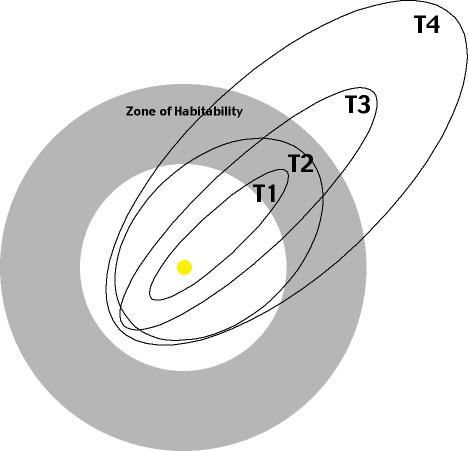
picture of elliptical orbit that Johannes Kepler had proposed.
Source 11
http://en.wikipedia.org/wiki/Johannes_Kepler
Johannes Kepler was a German mathematician, astronomer, and astrologer. He is best known for his eponymous laws of planetary motion which said that Kepler discovered that the Sun was indeed in the center of the universe like Copernicus had said, but also disproved Copernicus by saying that the planets revolving around the sun were not revolving around it circular, but rather elliptical, with the sun toward the end of the elipse instead of at the center. Kepler lived in an era where there was no clear distinction between astronomy and astrology.
Johannes Kepler was a German mathematician, astronomer, and astrologer. He is best known for his eponymous laws of planetary motion which said that Kepler discovered that the Sun was indeed in the center of the universe like Copernicus had said, but also disproved Copernicus by saying that the planets revolving around the sun were not revolving around it circular, but rather elliptical, with the sun toward the end of the elipse instead of at the center. Kepler lived in an era where there was no clear distinction between astronomy and astrology.
Daily Post 02/25/09
- My next action entering into the day is to find out how Kepler changed the model of the universe after Copernicus changed Ptolemy's model, and to get 4 more index cards.
- Today, I found four more index cards like I needed to do, and I found out more information about the German mathematician Johannes Kepler, who discovered that the planets in our solar system revolve around the sun not circular, like Copernicus had said, but elliptical (egg-shaped). He also created Kepler's laws of planetary motion which explains scientifically and mathematically how the planets revolve around the sun. Also, today I found how the events went in order by finding the timeline of 1451-1733 as one of my index cards.
- What I did today helps answer my research question because now I know who found out the elliptical orbit of the planets and how they found it out.
- My next action is to find out more about the next great scientist that contributed greatly to the scientific revolution, Isaac Newton, and how he developed the universal law of gravitaion.
Monday, February 23, 2009
Source 10
http://www.phy.hr/~dpaar/fizicari/xcopern.html
Nicolaus Copernicus was born on February 19, 1473 in Thorn, Poland and died May 24, 1543.
He made many impacts in the scientific revolution and made many new models, he was really smart!
Nicolaus Copernicus was born on February 19, 1473 in Thorn, Poland and died May 24, 1543.
He made many impacts in the scientific revolution and made many new models, he was really smart!
Source 9
http://en.wikipedia.org/wiki/Nicolaus_Copernicus
Nicolaus Copernicus was the first person to make a model of the universe that didn't have the Earth at the center of the universe. His book "On the Revolutions of Celestial Spheres" has said to be the starting point of modern astronomy and also what mainly began the Scientific Revolution.
Nicolaus Copernicus was the first person to make a model of the universe that didn't have the Earth at the center of the universe. His book "On the Revolutions of Celestial Spheres" has said to be the starting point of modern astronomy and also what mainly began the Scientific Revolution.
Source 8
http://www-groups.dcs.st-and.ac.uk/~history/Biographies/Ptolemy.html
A biography about Ptolemy, what he did, what he discovered (formulas and equatinos) and his background information about his life.
A biography about Ptolemy, what he did, what he discovered (formulas and equatinos) and his background information about his life.
Daily Post 02/23/09
- My next action entering into the day is to find out more information, mainly about Copernicus and Kepler and how they got involved in the scientific revolution and how this impacted and affected people around them, and the Catholic Church.
- Today, I did research on other scientists, mainly Copernicus, and how different his model of the universe is compared to that of Ptolemy's.
- This helps answer my research question because now I know how the model of the universe started to grow and change during the scientific revolution.
- My next action is to find out how Kepler changed the model of the universe after Copernicus changed Ptolemy's model.
Source 7
My world history book- on chapter 10, it gives informatino about the scientific revolution, how it got started, who was involved, and how the Enlightenment followed up afterwards.
Source 6
http://www.vikdhillon.staff.shef.ac.uk/teaching/phy105/celsphere/ptolemy.gif
Picture of the first model of the universe that Ptolmey had created. The Catholic church liked his model because it didn't threatened any of their beliefs and they felt like they were in the middle of the whole universe, and they knew where the "celestial bodies" were (sphere of stars).
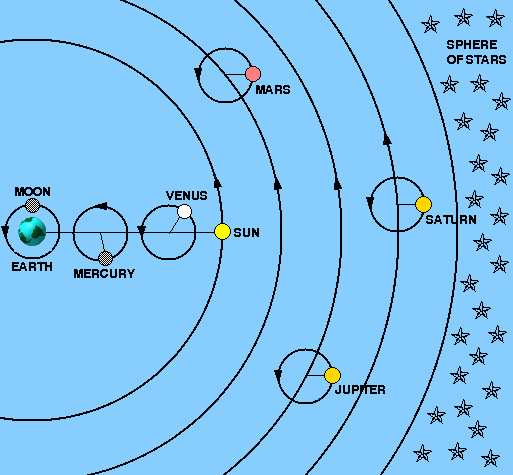
Picture of the first model of the universe that Ptolmey had created. The Catholic church liked his model because it didn't threatened any of their beliefs and they felt like they were in the middle of the whole universe, and they knew where the "celestial bodies" were (sphere of stars).
Source 5
http://en.wikipedia.org/wiki/Ptolemy
Ptolemy was a Greek mathematician, astronomer, geographer and astrologer. He lived in Roman Egypt. His name suggests that he was a Roman citizen. This article explains what and how Ptolemy did to contribute to the model of the Earth and the universe.
Ptolemy was a Greek mathematician, astronomer, geographer and astrologer. He lived in Roman Egypt. His name suggests that he was a Roman citizen. This article explains what and how Ptolemy did to contribute to the model of the Earth and the universe.
Daily Post 02/20/09
- My next action entering into the day was to find more information about more scientists that contributed to the world of science during the scietific revolution.
- Today, I found out more information about other scientists in the scientific revolution, especially Claudius Ptolemy and how his model revolutionized the science world and it gave a certain view of the universe.
- What I did today that will help m answer my research question is that I found out more about one of the scientists that greatly contributed to the scientific revolution.
- My next action is to learn more about other cientists next time, especially Copernicus and Kepler.
Thursday, February 19, 2009
Source 4
http://en.wikipedia.org/wiki/Galileo_Galilei
this website deescribes Galileo Galilei and how he contributed to the scientific revolution and in what ways.
this website deescribes Galileo Galilei and how he contributed to the scientific revolution and in what ways.
Daily Post 02/19/09
- My nextaction entering into the day was to find atleast two more sources for my project of the scientific revolution.
- Today, I accomplished what I was suppose to do and I found atleast two more sources!
- This helps answer my research question because I learned about how the revolution got started and some of the contributions made by some of the scientist, like Galileo Galilei.
- My next action for the next day is to find more sources and find informatin about more scientists and how they contributed to the scietific revolution.
Source 3
http://vlib.iue.it/carrie/texts/carrie_books/gilbert/23.html
describes the beginning of the scientific revolution and how it got started, and how during the revolution, and before it started, how people thought and how people thought the ideal man was suppose to be like.
describes the beginning of the scientific revolution and how it got started, and how during the revolution, and before it started, how people thought and how people thought the ideal man was suppose to be like.
Daily Post 02/12/09
- My next action entering into the day is to continue researching about my topic and finding more sources.
- Today I found more sources and learned some more information about my topic, the scientific revolution.
- This helps answer my research question because I found some more information about my topic and it helped me understand how the inventions and progresses during the scientific revolution affected how the science world works today.
- My next action for next time is to find at least two more sources for my project.
Tuesday, February 17, 2009
Source 2
http://wsu.edu/~dee/ENLIGHT/SCIREV.HTM
history before the scientific revolution started, starts in middle ages and talks about how the economy and community was before the revolution
history before the scientific revolution started, starts in middle ages and talks about how the economy and community was before the revolution
Source 1
http://en.wikipedia.org/wiki/Scientific_Revolution#New_Ideas
A time period in which many scientists call the Scientific Revolution because it is commonly viewed as the foundation and origin of modern science. New ideas arose, new organizations and institutions were established for the study of the natural world.
A time period in which many scientists call the Scientific Revolution because it is commonly viewed as the foundation and origin of modern science. New ideas arose, new organizations and institutions were established for the study of the natural world.
Daily Post 02/11/09
- My next action entering into the day was to start my research on my topic and bookmark some websites for my sources.
- Today, I found two new sources, so I accomplished my goal for today!
- This helps answer my research question because it is giving me more information about my topic
- My next action is to keep looking up some more sources and learn more about the scientific revolution
Monday, February 9, 2009
7 Questions
1) research question: how has the scientic revolution affected the science world today?
2) description of form of project: several models showing the advances of science made during the scientific revolution
3) justification of this form: I chose this form of project because I think it best represents what the scientific revolution was about and how it has helped develop countries around the world.
4) definition of finished product: a 3D model of the accomplishments made during the scientific revolution
5) justification that finished product shows mastery: this type of project answers my wuestion because it will be showing models of science from then and discuss how it has affected the science world today.
6) task breakdown/work flow of project: first, I will research my topic, take notes and find sources for my topic, save them on delicious.com, and use the information to make my model look great for Exhibition Night.
7) the next actions to be taken on this project: research more about my topic
2) description of form of project: several models showing the advances of science made during the scientific revolution
3) justification of this form: I chose this form of project because I think it best represents what the scientific revolution was about and how it has helped develop countries around the world.
4) definition of finished product: a 3D model of the accomplishments made during the scientific revolution
5) justification that finished product shows mastery: this type of project answers my wuestion because it will be showing models of science from then and discuss how it has affected the science world today.
6) task breakdown/work flow of project: first, I will research my topic, take notes and find sources for my topic, save them on delicious.com, and use the information to make my model look great for Exhibition Night.
7) the next actions to be taken on this project: research more about my topic
Subscribe to:
Posts (Atom)